Key Takeaways
- The Argolis circuit covers Mycenae, Epidaurus and Nafplio in one full day, roughly 8 to 10 hours from Athens.
- Visit Mycenae first while energy is high, Epidaurus second, and save Nafplio for lunch and a waterfront walk.
- Mycenae predates the Parthenon by about a thousand years; the Lion Gate is the oldest monumental sculpture in Europe.
- A private tour is the practical way to cover all three sites; public transport between them is tight for a single day.
In this guide
If someone asked us to recommend a single full-day trip from Athens that gives the most variety, the deepest history, and the most rewarding drive, the answer without hesitation is the Argolis circuit.
Three sites, three completely different experiences, all within a day's reach of Athens. By the time you eat lunch in Nafplio with a view of the harbour, you will have walked through a Bronze Age citadel that predates the Parthenon by a thousand years, and you will have stood in a theatre so acoustically perfect that it has not been significantly improved on in 2,400 years.
3
Sites in one day
1.5–2 hrs
Drive from Athens
3,500 yrs
Of history covered
8–10 hrs
Full day total
Why This Day Trip Punches Above Its Weight
The Argolis region in the Peloponnese sits roughly 1.5 to 2 hours from Athens. The drive is straightforward. But the three sites it contains, taken together, cover more historical ground than almost any other day trip from the city.
Mycenae: Bronze Age civilisation at its most powerful, roughly 1300 BCE. Epidaurus: Classical Greek theatre at its most refined, roughly 4th century BCE. Nafplio: The first capital of the modern Greek state, 1820s.
Three and a half thousand years of history in one day.
Mycenae: The Bronze Age Citadel
What It Is
Mycenae was the power centre of the Late Bronze Age Greek world. Between approximately 1600 and 1100 BCE, the Mycenaean civilization dominated the Aegean. Mycenae itself was the seat of its greatest king, Agamemnon: commander of the Greek forces in the Trojan War according to Homer's Iliad.
Whether you approach Mycenae as myth or history (and the line between the two is blurrier here than almost anywhere in Greece), the site is extraordinary. These are not reconstructed ruins. These are the actual stones of a civilization that collapsed more than 3,000 years ago.
The Lion Gate
The main entrance to the citadel is the Lion Gate, built around 1250 BCE. Above the doorway, two carved lions stand facing a central column. It is the oldest monumental sculpture in Europe. Walk under it and into the citadel beyond.
The Treasury of Atreus
Just below the main citadel entrance lies what is called the Treasury of Atreus (though it is almost certainly a royal tomb rather than a treasury). This is a monumental beehive-shaped chamber tomb, approximately 14 metres high and 14 metres in diameter, with a corbelled stone ceiling. The lintel stone over the entrance weighs roughly 120 tonnes.
It was built around 1250 BCE. The engineering precision involved in constructing it without mortar and without modern tools is genuinely hard to process when you are standing inside.
How Long to Spend
Allow at least 1.5 hours at Mycenae, including the Treasury of Atreus. The site is not enormous, but there is a lot to absorb and the uphill walk to the citadel proper takes time.
Epidaurus: The Perfect Theatre
What It Is
Epidaurus was one of the most important healing sanctuaries of the ancient Greek world, dedicated to Asclepius, the god of medicine. Patients came from across Greece to sleep in the sanctuary hoping for cures. The site was also a major festival venue.
The sanctuary itself contains interesting ruins: temples, the circular Tholos building, patient dormitories, and various structures. But the reason most visitors come is the theatre.
The Theatre
The ancient theatre of Epidaurus is the best-preserved ancient theatre in Greece, and possibly in the world. It seats approximately 14,000 people across 55 rows of limestone seats. It was built in the 4th century BCE, most likely by the architect Polykleitos the Younger.
The acoustics are the thing. Stand at the centre of the circular orchestra (the performance space at the bottom) and speak in a normal voice. From the back row at the top of the cavea, that voice is clearly audible. Not just perceptible: clearly audible. The geometry of the theatre creates a sound environment that modern engineers have studied extensively and still cannot fully explain.
Even outside performance season, ask someone in your group to stand at the centre while you go to the top row. Drop a coin on the stone. You will hear it.
Try the acoustics yourself
Stand at the centre of the orchestra and speak in a normal voice. Send someone to the top row. It works every time, and it is the moment most people remember from the whole day.
How Long to Spend
Allow 1 to 1.5 hours at Epidaurus. The theatre is the main draw but the surrounding sanctuary ruins are worth a walk.
Nafplio: Lunch and the First Capital
What It Is
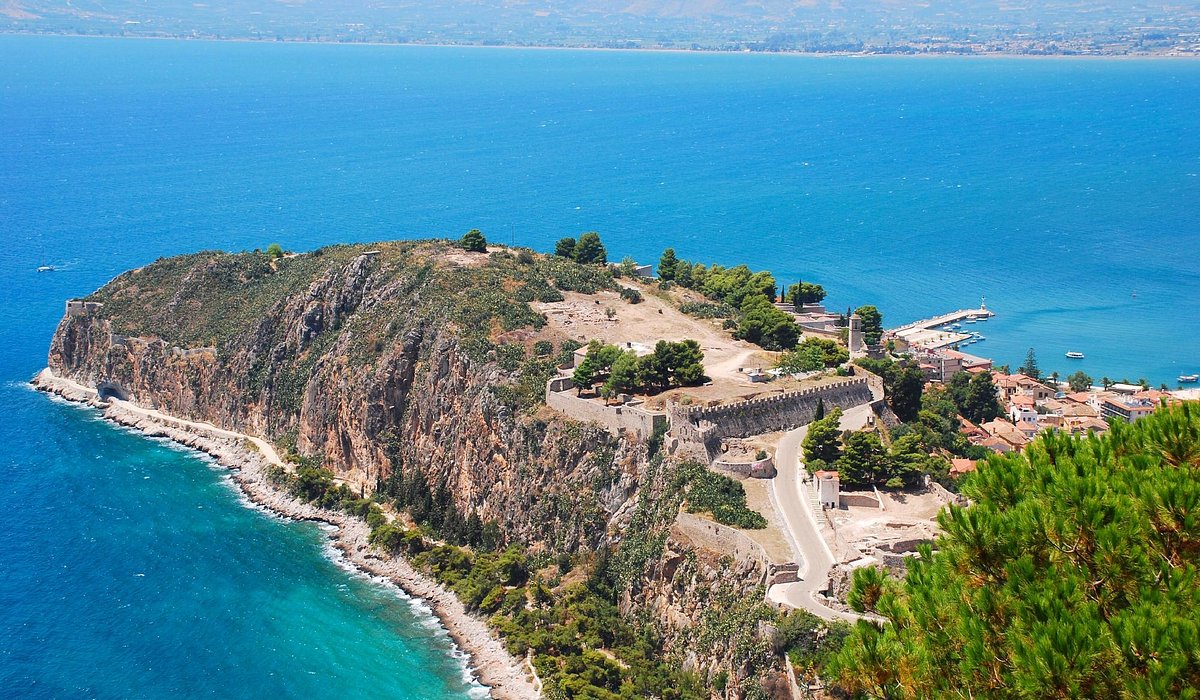
Nafplio is one of the most beautiful towns in Greece and has been called one of the most beautiful in the whole of Europe. It is compact, walkable, and full of good food. It is also historically significant: after Greek independence from Ottoman rule in the 1820s, Nafplio served as the first capital of the modern Greek state.
The Architecture
The old town is a mix of Venetian and Ottoman architecture, with neoclassical buildings added in the 19th century during the capital period. The narrow streets, the squares, and the waterfront promenade are all very well maintained. Wandering through the old town on foot is one of the better half-hours you will spend in Greece.
Palamidi Fortress
Above the town, on a 216-metre-high hill, stands the Palamidi fortress: a massive Venetian-built structure from the early 18th century with 999 steps up from the town below (the number is traditional, the exact count varies). The view from the top encompasses the entire Argolic Gulf and most of the Argolis plain. If you have energy left after Mycenae and Epidaurus, the climb is worth it.
The Bourtzi
In the middle of Nafplio's harbour sits the Bourtzi: a small fortified island with a tower, originally built by the Venetians. It is accessible by a short boat ride from the harbour and forms the centrepiece of the view from the waterfront.
Lunch in Nafplio
Nafplio is where you eat. The town has a large number of good tavernas and restaurants in all price ranges, concentrated around the main square (Syntagma Square in Nafplio) and along the waterfront. Fresh seafood, grilled meats, and classic Greek mezedes are all available. Plan to spend an hour here.
How to Get from Athens to the Argolis
Private Tour
The most practical option for covering three sites in one day. We handle the logistics, the order of visits, and the timing between sites. A private vehicle means no waiting for coaches and no group constraints.
The standard order on this tour: Mycenae first (while energy levels are high and the morning light is good), Epidaurus in the late morning, and Nafplio for lunch and an afternoon walk before the return to Athens.
Book Theo Travel's Private Argolis Full Day Tour from EUR 400, up to 14 persons, free cancellation.
Group Tour
Organised group tours to Mycenae, Epidaurus, and Nafplio depart daily from Athens in the main season. They are cheaper per person than a private tour and follow a set schedule. Check GetYourGuide and Viator for current options.
Public Transport
Getting from Athens to the Argolis by public transport is possible but complex. You would need to take a KTEL bus to Nafplio (approximately 2 hours from Athens Terminal A, with a change in Corinth), and then use local taxis or buses to reach Mycenae and Epidaurus, which are not in Nafplio itself.
For a single day covering all three sites, public transport makes the logistics very tight. It is more realistic for a two-day trip where you stay overnight in Nafplio.
How Much Time You Need and How to Plan the Day
A comfortable full day covers all three sites without rushing. Here is a realistic schedule for a private tour departing central Athens:
07:30: Depart Athens
09:30: Arrive Mycenae (1.5 hours on site, including Treasury of Atreus)
11:00: Depart for Epidaurus
11:30: Arrive Epidaurus (1 to 1.5 hours on site)
13:00: Depart for Nafplio
13:30: Lunch in Nafplio (1 hour), walk the old town
15:30: Depart Nafplio for Athens
17:30 to 18:00: Return to Athens
This leaves a comfortable margin. You can adjust the pace at each site to suit your group.
Practical Tips
Order of visits: Mycenae first, Epidaurus second, Nafplio third. This is not arbitrary: Mycenae is the most strenuous (uphill walking in the citadel), and it is better tackled with morning energy. Nafplio last means you eat lunch at the most pleasant stop.
Footwear: Proper closed-toe shoes are essential. The path up through the Mycenaean citadel is rocky and uneven. Epidaurus involves grass and uneven stone. Sandals are a bad idea.
Tickets
Each site has its own entrance fee. Prices are set by the Greek Ministry of Culture. Verify current costs at the site or on the official Ministry of Culture website before your visit.
What to bring
Water (the Mycenaean citadel is exposed and hot in summer), sun protection, and cash for site entrances and lunch.
Is Mycenae worth visiting? Yes, but the experience is significantly richer with some context. Without knowing something about Mycenaean civilisation and the Trojan War cycle, the ruins can feel sparse. A private guide or a good audio guide makes an enormous difference at Mycenae specifically.
FAQ: Nafplio, Mycenae and Epidaurus Day Trip
How far is Mycenae from Athens? Mycenae is approximately 120 kilometres from Athens. The drive takes 1.5 to 2 hours.
Can you do Mycenae, Epidaurus and Nafplio in one day? Yes, comfortably. The three sites are close to each other in the Argolis region, and a full day (departing Athens at 7:30 to 8:00 and returning by 17:30 to 18:00) covers all three without rushing.
Is Mycenae worth visiting? Yes. Mycenae is the best-preserved Late Bronze Age citadel in Greece and contains some of the oldest monumental architecture in Europe, including the Lion Gate and the Treasury of Atreus. It is significantly more impressive with some historical context: read about Mycenaean civilisation and the mythological cycle of the Trojan War before you go.
How far is Epidaurus from Nafplio? Approximately 30 kilometres. The drive between the two takes about 30 minutes.
What is Epidaurus known for? The ancient theatre of Epidaurus, widely considered the best-preserved ancient theatre in the world. It is famous for its extraordinary acoustics: a voice or even a coin dropped at the centre of the stage is clearly audible at the highest row of seats. The theatre is also still used for live performances during the Athens and Epidaurus Festival in summer.
Is Nafplio worth visiting? Absolutely. Nafplio is one of the most beautiful towns in Greece, with a compact old town that mixes Venetian, Ottoman, and neoclassical architecture, excellent restaurants, and the Palamidi fortress above the town. It is a highlight of the Argolis day trip in its own right.
How do I get from Athens to Nafplio by public transport? KTEL buses depart from Athens Terminal A (Kifissos bus station) to Nafplio, usually with a change in Corinth. The journey takes approximately 2 to 2.5 hours. Check the KTEL website for current schedules.
What is the best time of year to visit the Argolis? Spring (April to June) and autumn (September to October) offer the best combination of comfortable temperatures and manageable crowds. Summer is hot and busy. Winter is viable but check the reduced opening hours of some sites.
Frequently Asked Questions
Yes, comfortably. The three sites are close to each other in the Argolis region. A full day departing Athens around 7:30 to 8:00 and returning by 17:30 to 18:00 covers all three without rushing.
Approximately 120 kilometres. The drive takes 1.5 to 2 hours depending on traffic.
Yes. Mycenae is the best-preserved Late Bronze Age citadel in Greece and contains some of the oldest monumental architecture in Europe, including the Lion Gate and the Treasury of Atreus. It is significantly richer with some historical context beforehand.
The ancient theatre of Epidaurus, widely considered the best-preserved ancient theatre in the world. It is famous for its extraordinary acoustics: a voice or even a coin dropped at the centre of the stage is clearly audible at the highest row of seats.
Absolutely. Nafplio is one of the most beautiful towns in Greece, with a compact old town mixing Venetian, Ottoman and neoclassical architecture, excellent restaurants, and the Palamidi fortress above the town. It is a highlight of the Argolis day trip in its own right.
Mycenae first while energy levels are high and morning light is good, Epidaurus in the late morning, and Nafplio for lunch and an afternoon walk before the return to Athens. Mycenae involves the most uphill walking, so tackle it early.