Key Takeaways
- Delphi is about 180 km northwest of Athens; allow 2.5 to 3 hours each way by car.
- Plan for 8 to 10 hours total: three to four hours on the ground covers the site, Tholos and museum properly.
- There is no train to Delphi; KTEL bus from Liosion terminal works but eats into your site time.
- Do not skip the Sanctuary of Athena Pronaia or the Archaeological Museum, especially the Charioteer of Delphi.
In this guide
Delphi was, for centuries, the most important place in the ancient Greek world. City-states sent delegations here before declaring war. Rulers came to ask about the future. Ordinary people made the journey from across the Mediterranean for a word from the Oracle. Whatever your level of interest in ancient history, standing on the slopes of Mount Parnassus where all of this happened is one of those experiences that stays with you.
The good news is that Delphi is a realistic day trip from Athens. The honest news is that it is not a short one. Here is everything you need to know before you go.
180 km
From Athens
2.5–3 hrs
Drive each way
4 hrs
Comfortable time on site
8–10 hrs
Full day total
How Far is Delphi from Athens and How Long Does It Take
Delphi is approximately 180 kilometres northwest of Athens. By private vehicle or organised transport, the journey takes roughly 2.5 to 3 hours each way, depending on traffic leaving the city.
The road takes you north out of Athens, through the Boeotian plain, and then into the mountains. The last section of the drive climbs into the foothills of Mount Parnassus. The landscape becomes increasingly dramatic as you approach the site, which sits on a steep hillside above a valley of olive trees stretching to the sea.
Allow a minimum of 8 hours for the full day trip. Comfortable is 10 hours: 3 hours each way and 4 hours on the ground, which gives you time for both the archaeological site and the museum without rushing.
How to Get from Athens to Delphi
Private Tour
This is the most efficient option for a day trip. You are picked up at your hotel in Athens, driven directly to Delphi, and brought back at the end of the day. No changes, no schedules to chase, and you spend all of the travel time sitting in a comfortable vehicle rather than navigating public transport in a country whose systems you may not know.
The other advantage of a private tour to Delphi is flexibility at the site. You are not tied to a group's schedule. If you want to spend more time in the museum or less time at a particular ruin, you can.
Book Theo Travel's Private Delphi Day Tour from EUR 400, up to 14 persons, free cancellation.
Group Tour
Organised day tours to Delphi run from Athens daily during the main season, typically departing early morning and returning in the evening. You share a coach with other tourists and follow a guide on a fixed itinerary. The cost per person is significantly lower than a private tour. The trade-off is a fixed pace, group dynamics, and a fixed schedule.
Check GetYourGuide or Viator for current options and prices.
KTEL Bus (Public Transport)
There is no direct train to Delphi. The public transport option is the KTEL intercity bus from Athens.
Buses depart from the Liosion (Terminal B) bus station in Athens, which is accessible by metro. The journey takes approximately 3 hours. Buses run several times daily, though the schedule is reduced on weekends and in the off-season. Check the KTEL website for current timetables before you go.
This is a good option for independent travellers on a budget, or anyone who enjoys the process of Greek intercity bus travel. The limitation for a day trip is the round journey: six hours on the bus leaves you limited time on the ground. An early departure is essential.
Driving Yourself
If you have rented a car, Delphi is a straightforward drive from Athens. The route is well-signposted. Parking is available near the site. The drive through the mountains at the end is narrow in places but perfectly manageable with a standard car.
What You Will See at Delphi
The Delphi archaeological area is divided into two main sections on opposite sides of the main road, plus the museum. Plan to see all three.
The Main Archaeological Site
The entrance leads you onto the Sacred Way, the paved path that ancient pilgrims walked from the entrance up to the Temple of Apollo. Along the way stand the remains of the treasuries: small buildings erected by various Greek city-states to store offerings to Apollo and to display their wealth and piety. The Athenian Treasury is the best preserved and was partially reconstructed in the early 20th century.
The path continues uphill to the Temple of Apollo itself. This is where the Oracle sat. The Pythia, a priestess of Apollo, would enter the inner sanctuary and deliver her prophecies, which were then interpreted by priests. Rulers and generals, merchants and private citizens: all came to ask her questions. The responses, famously ambiguous, shaped decisions that changed history.
Above the temple is the ancient theatre, which seated approximately 5,000 people and offered a panoramic view of the entire valley below. Higher still is the ancient stadium, one of the best preserved in Greece, where the Pythian Games were held.
Allow two hours minimum for the main site, more if you want to walk at a relaxed pace.
The Sanctuary of Athena Pronaia
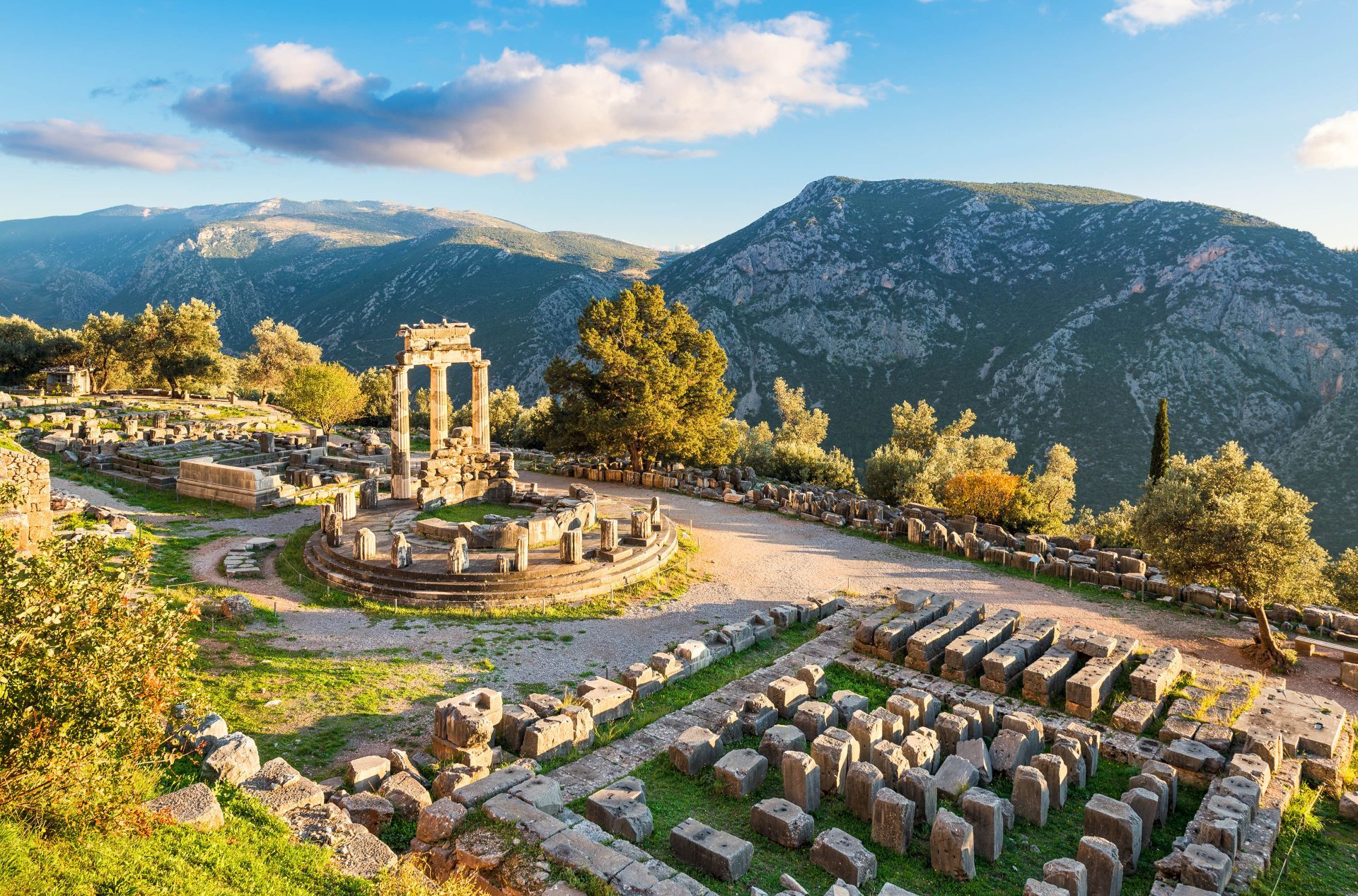
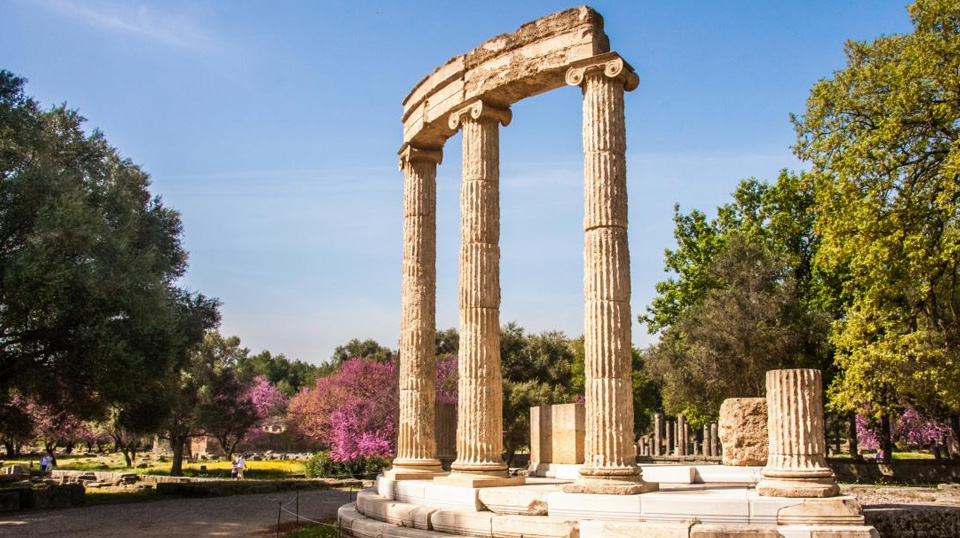
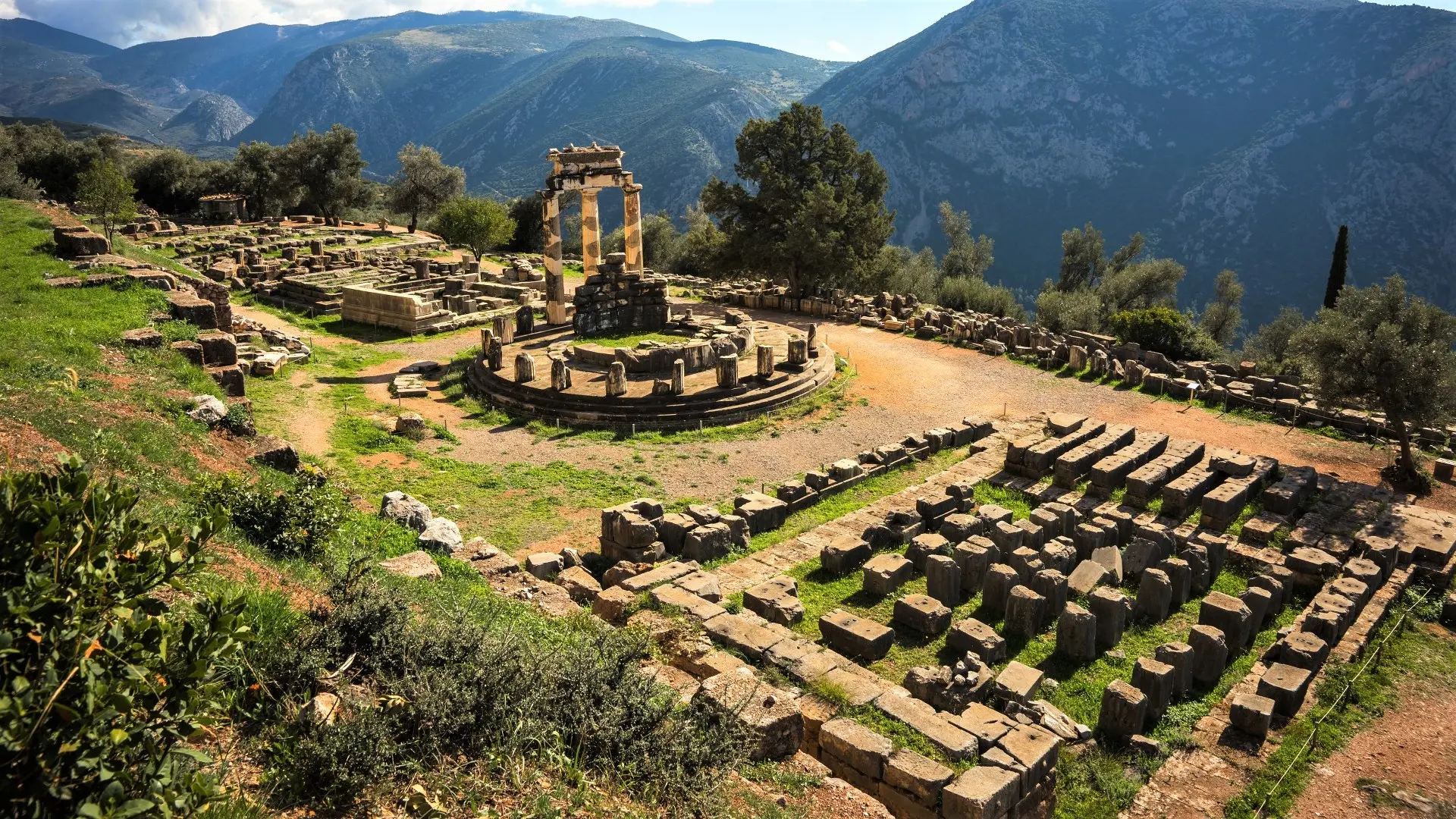
Cross the main road and follow the path downhill (or uphill, depending on your approach) to the Sanctuary of Athena Pronaia. This is where the famous circular Tholos stands: a round marble structure from the 4th century BCE whose purpose is still debated by archaeologists. Three columns have been re-erected and the structure is one of the most photographed in all of Greece.
This section of the site is less crowded than the main area and often overlooked by visitors on tight schedules. Do not skip it.
Do not rush the Tholos
Most coach groups spend their time on the Temple of Apollo and skip Athena Pronaia entirely. Cross the road and walk down to the Tholos. It is quieter, photogenic, and takes less time than you think.
The Delphi Archaeological Museum
The museum is immediately adjacent to the main site entrance and is included in the combined ticket. It houses the finds from the Delphi excavations and is one of the best archaeological museums in Greece.
The standout piece is the Charioteer of Delphi: a life-size bronze statue from around 475 BCE, so well preserved that you can see the individual copper eyelashes. It is one of the finest surviving examples of ancient Greek bronze sculpture.
Allow at least one hour in the museum.
Private Tour vs Group Tour vs Doing It Yourself
Here is the honest comparison:
Private tour
The most time-efficient option. Door-to-door, no logistics, maximum flexibility at the site. Best for couples, families, anyone with a tight schedule, or anyone who values comfort over price.
Group tour
Cheaper per person, works well for solo travellers, but you are at the mercy of the group's pace and the coach's schedule.
KTEL bus
Best for budget travellers and those who enjoy independent travel. Requires an early start, leaves less time at the site, and involves more logistics. Perfectly manageable if you plan properly.
Self-drive: Good if you have a rental car and enjoy driving. The mountain road is scenic and the drive is part of the experience.
Best Time to Visit Delphi and Practical Tips
Best seasons
Spring (April to June) and early autumn (September to October) offer the best conditions: comfortable temperatures, lower crowds, and the wildflowers on the hillsides in spring are genuinely beautiful. Summer is hot and the site is exposed. Winter is viable and the mountains can have snow, which is atmospheric.
Opening hours
The site and museum have standard Greek archaeological site hours. These vary by season and are updated periodically. Check the official Greek Ministry of Culture website or confirm with your tour operator before you go. Do not arrive assuming specific hours without checking.
Tickets
A combined ticket covers the main archaeological site and the museum. Entrance to the Sanctuary of Athena Pronaia is separate and (at the time of writing) free. The ticket situation at Greek sites can change, so verify current pricing at the entrance or on the official site.
Footwear: The site involves significant uphill walking on uneven stone paths. Wear proper shoes. This is not a sandals destination, especially in summer when the stone is hot.
What to bring
Water (the site has limited shade), sunscreen, and comfortable walking shoes. A light layer for the mountain air even in summer.
Time needed on the ground
A minimum of 3 hours covers the main site and museum at a brisk pace. Four hours is comfortable. Five hours lets you take your time and have lunch in the nearby town of Delphi before or after.
Can You Combine Delphi and Meteora in One Day
No. The question comes up regularly and the answer is always the same: it is not realistic.
Delphi is 180 kilometres northwest of Athens. Meteora is 350 kilometres north. They are not close to each other. Attempting to cover both in a single day would mean roughly 500 kilometres of driving on top of visits to two of the most significant sites in Greece. You would see neither properly.
If you want to see both and have limited time, the most efficient approach is Delphi as a dedicated day trip from Athens, and Meteora as either a long day or an overnight excursion. If you want to combine them into one trip, a custom multi-day itinerary makes sense.
Request a custom Delphi and Meteora itinerary
FAQ: Delphi Day Trip from Athens
How far is Delphi from Athens? Approximately 180 kilometres. The drive takes 2.5 to 3 hours depending on traffic.
Is Delphi worth a day trip from Athens? Yes, unambiguously. Delphi is one of the most significant and atmospheric ancient sites in Greece. The combination of the archaeological remains, the museum, and the mountain setting makes it one of the best day trips available from the city.
Can you get from Athens to Delphi by train? No. There is no direct train service to Delphi. The public transport option is the KTEL bus from Athens Terminal B (Liosion station). The journey takes approximately 3 hours.
How long do you need at Delphi? A minimum of 3 hours to cover the main site and museum at pace. Four hours is comfortable. If you want to walk slowly, eat lunch in the town, and browse the museum properly, plan for five hours.
What is the best time of year to visit Delphi? Spring (April to June) and early autumn (September to October) are ideal. The temperatures are comfortable, crowds are lower than peak summer, and the landscape around the site is at its most attractive.
Is there a direct bus from Athens to Delphi? Yes. KTEL buses depart from Athens Terminal B (Liosion bus station) several times daily. The journey takes approximately 3 hours. Check the current KTEL timetable online before travelling, as schedules vary by day and season.
What is Delphi famous for? Delphi was the home of the Oracle of Apollo: a priestess (the Pythia) who delivered prophecies consulted by rulers, generals, and individuals from across the ancient Greek world. It was also the site of the Pythian Games (forerunner of the Olympic Games), and was considered by the ancient Greeks to be the centre of the world, marked by a stone called the Omphalos (the navel of the earth). The site also contains some of the finest surviving examples of ancient Greek architecture and sculpture, including the Charioteer of Delphi.
Frequently Asked Questions
Approximately 180 kilometres northwest. The drive takes 2.5 to 3 hours each way depending on traffic leaving the city.
Yes, unambiguously. Delphi is one of the most significant and atmospheric ancient sites in Greece. The combination of the archaeological remains, the museum, and the mountain setting makes it one of the best day trips available from the city.
No. There is no direct train service to Delphi. The public transport option is the KTEL bus from Athens Terminal B (Liosion station), which takes approximately 3 hours.
A minimum of 3 hours covers the main site and museum at a brisk pace. Four hours is comfortable. Five hours lets you walk slowly, eat lunch in the town, and browse the museum properly.
Spring (April to June) and early autumn (September to October) are ideal. Temperatures are comfortable, crowds are lower than peak summer, and the wildflowers on the hillsides in spring are genuinely beautiful.
No. Delphi is 180 kilometres northwest of Athens and Meteora is 350 kilometres north. They are not close to each other. Attempting both in a single day would mean seeing neither properly. Do them on separate days or design a custom multi-day itinerary.