Key Takeaways
- Two days covers the Acropolis, Acropolis Museum, Ancient Agora, Plaka, Monastiraki, and a Cape Sounion sunset.
- Book timed Acropolis tickets online before you arrive — they sell out in peak season, sometimes weeks ahead.
- Day 1 is the ancient city on foot; Day 2 is flexible morning plus Cape Sounion at sunset.
- Stay within a 15-minute walk of the Acropolis — Plaka, Monastiraki, Koukaki, or Syntagma all work well.
In this guide
Two days in Athens is enough to see the main monuments and understand the city. It is not enough to feel like you have fully absorbed it, because Athens does not work that way. But two focused days, planned well, leaves you with the Acropolis, the ancient Agora, Plaka, Monastiraki, and Cape Sounion at sunset. That is a satisfying and genuinely complete experience of what this city is.
This itinerary is built to be realistic, not aspirational. It does not pretend you can squeeze 12 hours of walking into a hot summer afternoon. It gives you breathing room to eat well, move at a human pace, and remember that you are on holiday.
2 days
Core sites covered
08:00
Best Acropolis slot
2 hrs
On the Acropolis
€250
Sounion tour from
Is 2 Days Enough in Athens
The honest answer is: enough to see the essential sites, not enough to see everything.
Athens is a city of layers. The ancient city, the Byzantine city, the Ottoman city, the 19th-century neoclassical city, and the modern city all exist on top of and alongside each other. Two days covers the ancient layer well, the central neighbourhoods adequately, and leaves the rest for a longer trip or a return visit.
If you have the option, three days in Athens is significantly better than two. You keep Day 2 in the city instead of racing to Cape Sounion, and you spend Day 3 on one proper outing. If two days is what you have, here is how to use them well.
Practical Notes Before You Start
Acropolis tickets: timed-entry tickets for the Acropolis are required and sell out, sometimes weeks in advance in summer. Book online before you arrive in Athens. Do not assume walk-up tickets will be available. Aim for the earliest available morning slot: the site is coolest and least crowded in the first two hours.
Book Acropolis tickets first
Timed-entry tickets sell out in peak season — sometimes weeks ahead. Book online before you travel and aim for 08:00 or 09:00. Everything else in this itinerary flows from that slot.
Acropolis Museum tickets: a separate ticket from the Acropolis site. The museum is on the southern slope of the hill, a five-minute walk from the main entrance. Book or buy on arrival at the museum; it is less frequently sold out than the Acropolis itself.
Getting around
the central sites of Athens are within walking distance of each other. The Acropolis, the Agora, Monastiraki, Plaka, and Syntagma Square are all part of a compact, largely pedestrianised area. Comfortable shoes are more important than any other piece of advice in this itinerary.
Weather
Athens in summer (June to August) is very hot. Start early, take the midday hours slowly, and plan indoor activities (the museums) for the 13:00 to 15:00 window when the heat is at its peak.
Day 1: The Ancient City
Morning: The Acropolis
Start here. The Acropolis is the reason Athens is Athens and it should be approached with the time and attention it deserves. If you prefer a chauffeured day covering the Acropolis, museum and city viewpoints instead of navigating on foot, our Athens Full Day Tour is built for exactly that.
Your timed-entry slot should be as early as possible: 08:00 or 09:00 in summer, which is the window before the temperature climbs and before the tour groups arrive in force. From the main entrance on the south slope, the Sacred Way leads up to the Beule Gate and into the main site.
The Propylaea, the monumental gateway, comes first. Beyond it, the Parthenon: the largest Doric temple ever built, dedicated to Athena, constructed between 447 and 432 BCE under the direction of Pericles and the sculptor Pheidias. The ongoing restoration work on the Parthenon is visible and, if anything, makes the scale of the original construction more comprehensible.
To the northwest of the Parthenon stands the Erechtheion, famous for the Porch of the Caryatids: six draped female figures serving as columns. The ones you see are modern casts; the originals are in the Acropolis Museum. On the south slope, the Theatre of Dionysus, where ancient Greek drama was born, and the Odeon of Herodes Atticus, which is still used as a performance venue today.
Plan two hours minimum at the Acropolis itself. Do not rush it.
Late Morning: The Acropolis Museum
After the site, walk down to the Acropolis Museum. The museum was built directly above an archaeological excavation, so as you enter you walk on glass floors over the remains of an ancient Athenian neighbourhood.
The collection on the top floor, the Parthenon Gallery, is the highlight. The surviving original frieze blocks and pediment sculptures are arranged in their original order, with plaster casts filling the positions of pieces currently held in the British Museum in London. The layout makes a quietly powerful argument about where these objects belong.
Allow one to two hours in the museum.
Lunch: Plaka or Monastiraki
From the museum, walk into Plaka: the oldest continuously inhabited neighbourhood in Athens, immediately below the Acropolis. The streets are narrow, the buildings are low, and the tavernas spill onto the pavement. It is touristy and entirely worth it.
Eat at a table with an Acropolis view if you can find one. For lunch, the simpler the menu the better: grilled fish, horiatiki salad (Greek salad), and bread from a place that has been doing the same thing for decades is the appropriate meal.
Afternoon: Ancient Agora and the Temple of Hephaestus
After lunch, walk to the Ancient Agora of Athens, the civic centre of the ancient city where philosophers argued, merchants traded, and democracy was practised. Socrates walked here. So did Aristotle.
The site contains the best-preserved ancient Greek temple in the world: the Temple of Hephaestus, a Doric temple from the 5th century BCE that survived because it was converted to a Christian church early enough to protect it from dismantlement. It is easy to underestimate because it sits in the same city as the Parthenon. Objectively, it is extraordinary.
The Stoa of Attalos, reconstructed in the 1950s, now houses the Agora Museum. The collection is smaller and less famous than the National Archaeological Museum but worth an hour if you are interested in the details of daily Athenian life in antiquity.
Evening: Monastiraki and Dinner
From the Agora, you are already in Monastiraki. The square itself is lively and the surroundings are dense with shops, street food, and bars. The flea market (Monastiraki Flea Market) is along Ifaistou Street: a chaotic, genuine market selling antiques, second-hand items, and tourist goods in roughly equal measure.
For dinner, Psiri (the neighbourhood immediately north of Monastiraki) has some of the city's better tavernas: less tourist-oriented than Plaka, more local in character. Walk around and see what the Greeks are eating before you choose.
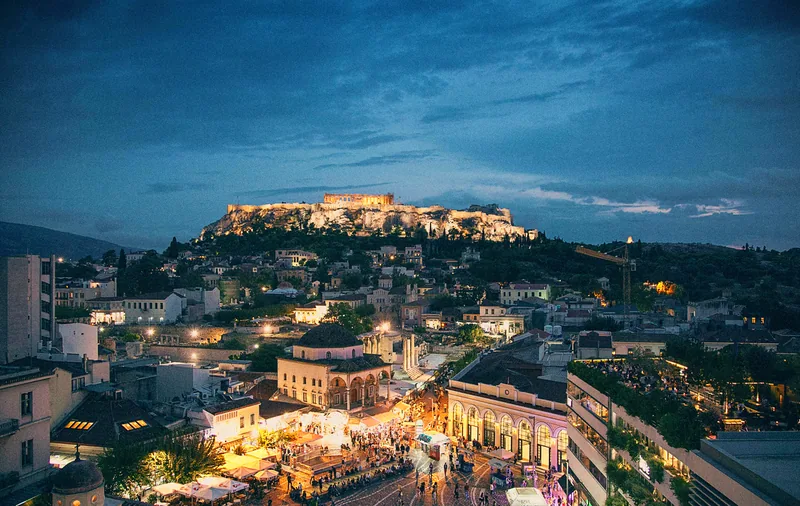
End the evening with Greek coffee or a drink at one of the rooftop bars in the area. The view of the illuminated Acropolis from a rooftop in Monastiraki in the evening is the image of Athens that stays with most visitors long after they leave.
Day 2: Cape Sounion and the Coast
Morning: Time in the City (Flexible)
Use the morning of Day 2 according to your priorities.
If you want more ancient Athens
visit the National Archaeological Museum, the largest collection of ancient Greek artifacts in the world. It is a 15-minute taxi ride from the Acropolis area and deserves three hours. The collection includes the Mask of Agamemnon, the Antikythera Mechanism, and the original Jockey of Artemision bronze.
If you want to see more of the modern city
walk through the neighbourhoods of Thissio (along the archaeological walkway below the Acropolis) or Koukaki (a quieter residential neighbourhood on the south side of the Acropolis hill). Coffee at a neighbourhood café, a walk through the street market.
If you want to leave the city
an early departure for Cape Sounion (next section) gives you maximum time at the temple.
Afternoon and Evening: Cape Sounion at Sunset
Cape Sounion is the natural conclusion to two days in Athens. One hour along the Athenian Riviera coast, the Temple of Poseidon on a cliff above the Aegean, and the best sunset in Attica.
The afternoon tour works logistically because the timing is built around the light. You leave Athens around 15:00 to 16:00, drive the coast road through Glyfada and Vouliagmeni and the Riviera beach towns, arrive at the cape an hour before sunset, and spend the best light of the day at a clifftop temple built in 444 BCE.
This is the day trip closest to Athens, the most visually immediate, and the one that requires the least of your energy on the second day of a city itinerary.
Book the Private Sounio Sunset Tour: from EUR 250, up to 14 persons, hotel pickup included.
If you want to combine Day 2 with the Acropolis in the morning and Sounion in the evening as a single private day covering both Athens and the coast, see our Athens and Cape Sounion Full Day Tour.
Where to Stay in Athens
The best central neighbourhoods for a two-day itinerary are: Plaka (immediately below the Acropolis, the most central and atmospheric but also the most tourist-dense), Monastiraki (lively, well-connected, very central), Koukaki (quieter, slightly south of the Acropolis, popular with repeat visitors and those who prefer a less touristy feel), and Syntagma (the most central location, close to the Parliament and the main square).
For most first-time visitors to Athens, anywhere within a 15-minute walk of the Acropolis works well for a two-day itinerary.
Getting to and from Your Athens Hotel
From the airport
for arrival, our private airport transfer picks you up in the arrivals hall and takes you directly to your hotel. Fixed price, flight monitoring, no queue. The metro is also available (Line 3, EUR 9, approximately 40 to 50 minutes).
To the airport at departure
allow 60 minutes from central Athens in normal conditions, more in rush hour. For a morning flight, a private city to airport transfer is the stress-free option.
Extending Your Trip: Day Trips That Pair Well with 2 Days in Athens
If you have a third day or are extending to three or four nights:
Day 3 option
Do not squeeze a second city sprint. Use the 3-day Athens itinerary and pick one outing: Sounio, Delphi, Argolis, or a Hydra day trip.
For a full overview of all day-trip options
The 15 Best Day Trips from Athens.
FAQ: 2 Days in Athens
Is 2 days enough in Athens? Enough to see the Acropolis, the Acropolis Museum, the Ancient Agora, Plaka, and Monastiraki, with time for a day trip to Cape Sounion. Not enough to see everything Athens has to offer. Three days is significantly better if your schedule allows.
What is the first thing to do in Athens? The Acropolis, as early in the morning as possible. Book timed-entry tickets online before your trip.
Do you need to book Acropolis tickets in advance? Yes. Timed-entry tickets are required and sell out in peak season, sometimes weeks ahead. Book online as early as possible. Walk-up availability on the day cannot be relied upon in summer.
How do I get from the Acropolis to the Acropolis Museum? They are a five-minute walk apart on the south slope of the Acropolis hill. From the main Acropolis entrance, walk downhill past the Theatre of Dionysus: the museum is directly ahead.
What is the best area to stay in Athens for a 2-day visit? Anywhere within a 15-minute walk of the Acropolis: Plaka, Monastiraki, Koukaki, or Syntagma. The sites are all walkable from these areas.
What should I eat in Athens? Horiatiki salad (Greek salad with feta), grilled octopus, souvlaki (pork or chicken on a skewer with pita), loukoumades (Greek honey doughnuts), and fresh-caught fish at a simple waterfront taverna. Stick to places where the Greeks are eating, not the ones with photographs of the food on the outside menu.
Is Athens safe for tourists? Yes. Athens is a safe city for tourists. As in any major European city, keep your phone and wallet secure in crowded areas like the Monastiraki flea market and the metro. Pickpocketing exists; serious crime targeting tourists is rare.
How do I get around Athens? Walk. The central sites are compact and the pedestrianised streets around the Acropolis, Plaka, and Monastiraki make walking the natural choice. For longer distances (airport, the National Archaeological Museum), taxis are inexpensive and readily available throughout the day.
Frequently Asked Questions
Enough to see the Acropolis, the Acropolis Museum, the Ancient Agora, Plaka, and Monastiraki, with time for a day trip to Cape Sounion. Not enough to see everything Athens has to offer — three days is significantly better if your schedule allows.
Yes. Timed-entry tickets are required and sell out in peak season, sometimes weeks ahead. Book online as early as possible and aim for an 08:00 or 09:00 slot. Walk-up availability on the day cannot be relied upon in summer.
The Acropolis, as early in the morning as possible. Book timed-entry tickets online before your trip. Allow two hours minimum on the hill, then walk down to the Acropolis Museum. See our Acropolis visiting guide for timing and ticket details.
Anywhere within a 15-minute walk of the Acropolis: Plaka, Monastiraki, Koukaki, or Syntagma. The main sites are all walkable from these neighbourhoods.
Use the morning flexibly — the National Archaeological Museum, a neighbourhood walk in Koukaki or Thissio, or an early start. In the afternoon and evening, head to Cape Sounion for the Temple of Poseidon at sunset. Our private Sounion tour starts from about €250 with hotel pickup.
A private airport transfer picks you up in arrivals and takes you directly to your hotel with a fixed price and flight monitoring. The metro (Line 3, about €9, 40 to 50 minutes) is also available for solo travellers with light luggage. See our airport transfer comparison for all options.